
Course Presentation
The summer school will last five days and will include:
1. In-person theoretical lectures (in the classroom and in the field)
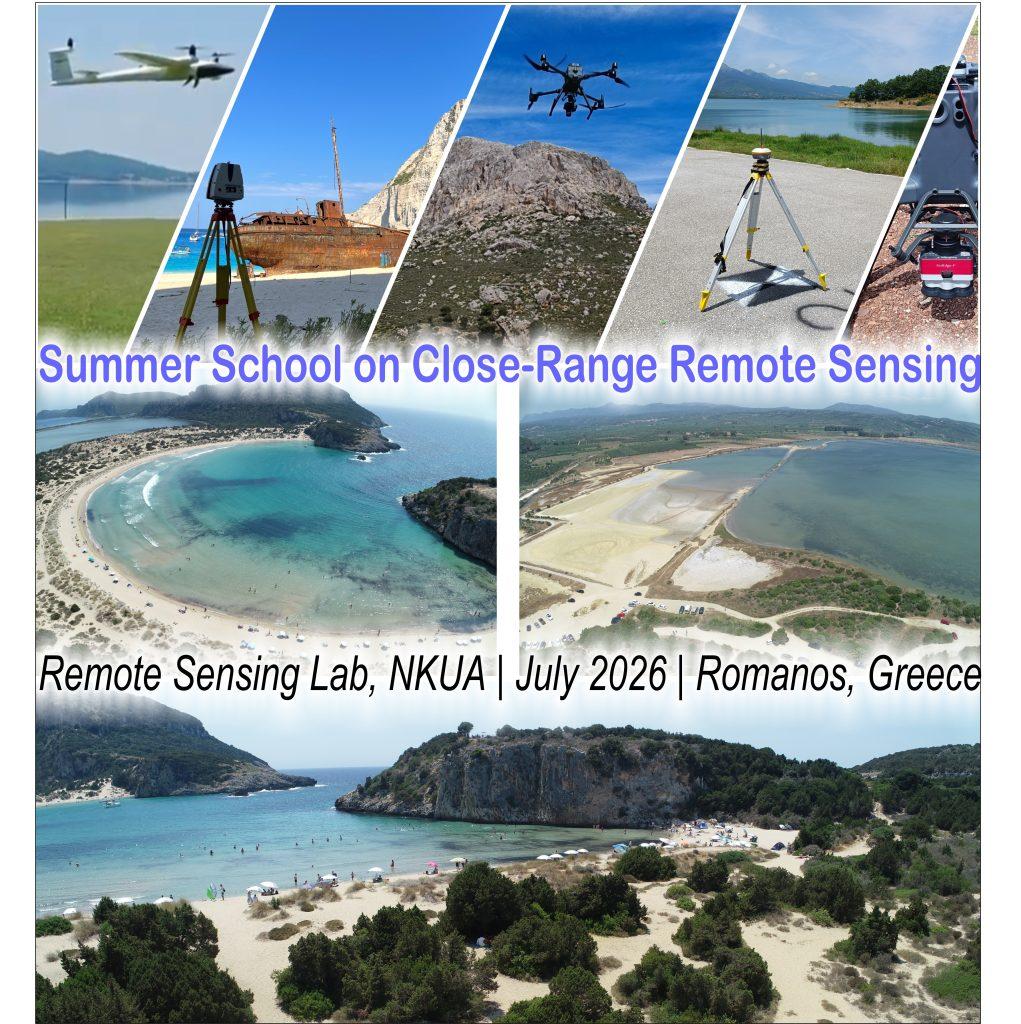
2. Outdoor practical training using latest equipment (UAS, TLS, RTK-GNSS)
3. Laboratory data processing with specialized software (e.g., Leica Cyclone, Agisoft Metashape, CloudCompare, GIS).
4. Collaborative learning through group projects and presentations
Learning Outcomes
Knowledge
Following completion of the Course participants should be able to:
1. explain the nature of the data collected by TLS, GNSS, and UAS equipment.
2. plan data collection using TLS for accurate and high-quality mapping of landforms or other targets.
3. plan appropriate flights for the collection of RGB, multispectral, and thermal aerial images using UAS (multirotor).
4. plan fixed-wing UAS flight missions for effective LiDAR-based point cloud acquisition.
5. process and integrate datasets from multiple sources (e.g., photogrammetry and 3D modeling) to produce comprehensive geospatial outputs.
6. interpret and evaluate the outcomes of various data processing workflows to ensure accuracy and reliability.
Skills (Psychomotor)
Following completion of the Course participants should be able to:
1. design remote sensing data collection missions based on scientific criteria and field constraints.
2. analyze and assess UAS, TLS, and GNSS datasets to generate high-precision geospatial products.
3. solve problems related to data quality, georeferencing, and merging of different sources.
4. apply creative processing methods for the production of three-dimensional models and orthophotos.
5. operate multirotor and fixed-wing UAS for performing photogrammetric data acquisition in real-world field environments.
6. operate a Terrestrial Laser Scanner (TLS) to acquire high-precision spatial data for geospatial applications.
7. use RTK-GNSS for georeferencing and accuracy verification.
8. process point clouds and generates Digital Terrain Models (DTMs), Digital Surface Models (DSMs), and orthophotos using specialized software.
Abilities (Social/Emotional)
Following completion of the Course participants should be able to:
1. collaborate effectively within teams to plan and execute complex fieldwork and data processing tasks.
2. communicate clearly and provide scientifically documented results in presentations and discussions.
3. demonstrate critical thinking in evaluating technological options and methodologies.
4. adapts to diverse fieldwork conditions and unforeseen situations.
5. embraces professional values related to safety, accuracy, and responsibility in data collection and processing.
6. promotes interdisciplinary collaboration and the adoption of innovative geospatial technology applications.
7. collaborates effectively in multicultural and interdisciplinary teams.